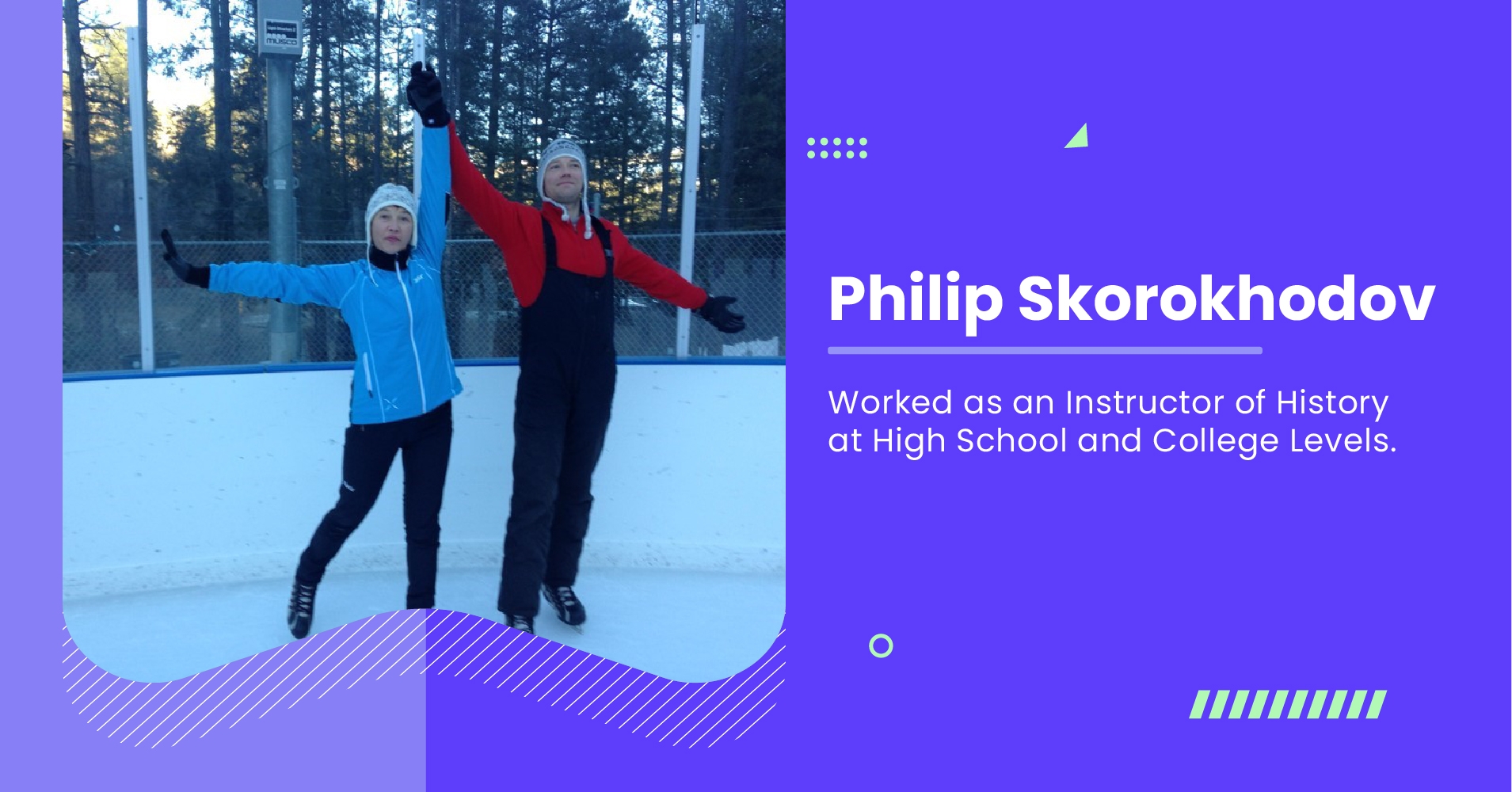
Philip Skorokhodov is a distinguished academic researcher known for his work in history, political science, and international relations, focusing particularly on World War II and urban studies in cities like Moscow and Paris. Fluent in Russian and French, his enthusiasm for teaching has led him to extensive roles as an instructor at both the high school and college levels.
Born and raised in Albuquerque, New Mexico, Philip attended Manzano Day School before progressing to Albuquerque Academy. He excelled academically, particularly in History and English, receiving multiple commendations. After high school, he pursued higher education at Swarthmore College in Pennsylvania, where he participated in the Honors Program and earned a Bachelor's degree in History with a minor in Political Science. His undergraduate thesis, "Who Won the War? Teaching the Young Generation: The Case of France (1946-2008)," examined how French educational systems addressed World War II history in the decades following the war.
During his junior year, Philip studied abroad in Paris, France, through the Internships in Francophone Europe program, deepening his understanding of French culture and politics. This experience fueled his passion for historical studies, leading him to the University of Chicago, where he earned a Master of Arts in Social Sciences. His thesis, "The Second World War Debates in Russia (2000-2010): Political and Academic Obsession," explored modern Russia's ongoing historical and political discussions. The range of courses he undertook included Latin American Civilization, Soviet History, and Contemporary European History.
Philip's scholarly pursuit continued at Arizona State University, where he began his PhD in History. His dissertation, "A Tale of Two Cities: Food, Hunger and Rationing in Moscow and Paris during WWII," focused on comparative urban survival strategies during the war. He remains ABD (All But Dissertation) despite completing all required coursework and exams.
His research has taken him around the globe, including extensive archival work in Moscow and Paris, focusing on wartime government rationing policies and their impacts on urban populations. He has contributed as a research assistant, working in Paris on projects about the abolition of the death penalty and, in New Mexico, translating critical Russian documents.
In addition to his research, Philip has a robust teaching background. He has taught history courses at Arizona State University and was an adjunct faculty member at Chandler-Gilbert Community College. He also temporarily taught Russian to elementary students. Beyond teaching, he worked part-time at the Albuquerque International Association, assisting with event planning and leading cultural and educational trips abroad.
Philip is bilingual in English and Russian, fluent in French, and proficient in Spanish.